The story of sev
Two centuries ago, wheat ran short. Sev is what replaced it.
A Bhil invention from Malwa, carried into the world under the name of the town that perfected it.
Wheat was replaced with besan. Vermicelli became fine golden strands. A substitution born of scarcity created something entirely new.
Malwa
A region that grew gram, not wheat
Sevaiyan — fine wheat vermicelli — was the familiar preparation across much of northern India. In Malwa it was the harder one to make. Black cotton soil and a dry season favour gram over wheat, and the kitchens here worked with what the land actually produced.
The substitution
Besan in place of wheat
Bhil cooks in the region made the exchange that defines the dish. Gram flour was seasoned, worked into a stiff dough, and pressed through a perforated ladle directly into hot oil — the same gesture as vermicelli, an entirely different flour.
The result
Not vermicelli at all
Wheat vermicelli softens. Besan does the opposite. The strands set fine, crisp and golden in the oil and broke cleanly under the tooth. The substitution had not imitated sevaiyan; it had produced something with no equivalent on the table.
The name
Bhildi Sev
It carried the name of the community that created it — Bhildi Sev, after the Bhils. Two centuries on, that attribution is the part most often dropped, so it is worth stating plainly: sev is a Bhil invention, and the industry that followed was built on it.
Ratlam
How a town's name reached the pack
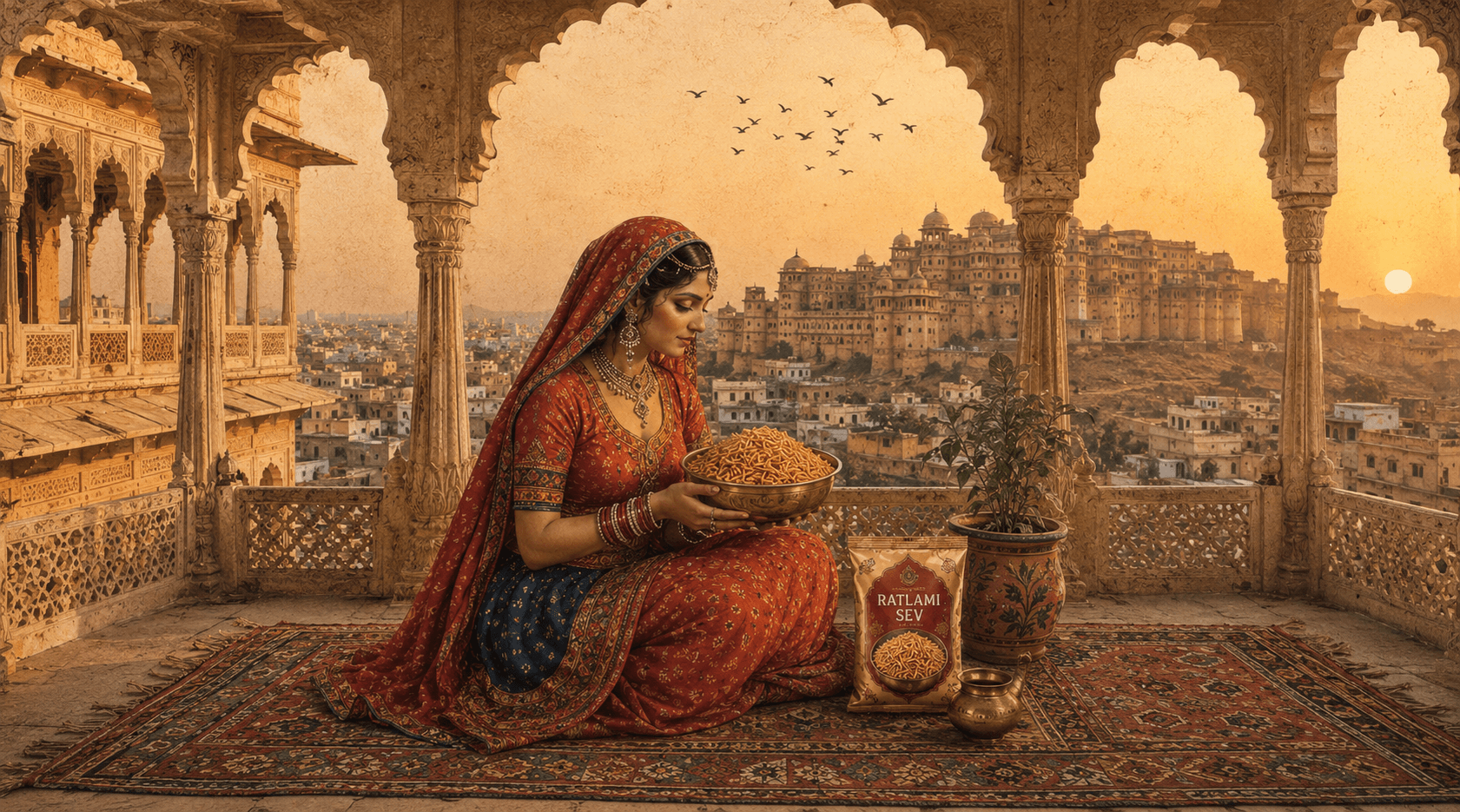
Ratlam's kitchens took up the preparation and shaped it: clove, black pepper and asafoetida pushed forward, the strand drawn finer, the fry held to a narrower window. Travellers began carrying it home. What was Bhildi Sev by origin became Ratlami Sev by reputation.
1900s
From household craft to trade
It remained a home preparation until the twentieth century, when Ratlam began producing it at scale and sev became something the town shipped rather than only served. Family units grew into establishments, and the recipe left the region for good.
2015
A protected name
Ratlami Sev received a Geographical Indication tag, formal recognition that the name belongs to a place and a method rather than to any single company. No brand owns this sev. Ratlam does.
Where we come in
We don't make this sev. We choose it.
The sev is made in Ratlam by people who have been making it for generations. We keep stock moving so the pack you open is close to its packing date, and we get it to your city intact.
The craft belongs to Ratlam. The delivery is ours.
This account is oral history before it is documented record, carried by the Bhil and Ratlam communities and reported in coverage of the GI application. Dates vary between tellings by a few decades. We credit the Bhils by name because the record often does not.